Kids predict whether everyday objects will float or sink, test them in a tub of water, and then meet a surprise: a pumice 'stone' that floats. Finish by sorting everything into labeled Float and Sink jars.
Small test objects (popcorn, raisins, pebbles, gravel, pom poms, bell) are choking hazards. Supervise closely, and leave them out for kids who still put things in their mouths.
Popcorn and raisins are test objects here, not a snack. Don't eat them after they've been in the water.
Always supervise children around a container of water, even a shallow one.
The post uses glass jars for sorting. Glass can break, so an adult should handle them or use clear plastic jars.
Wipe up splashes so no one slips.
Before the kids arrive
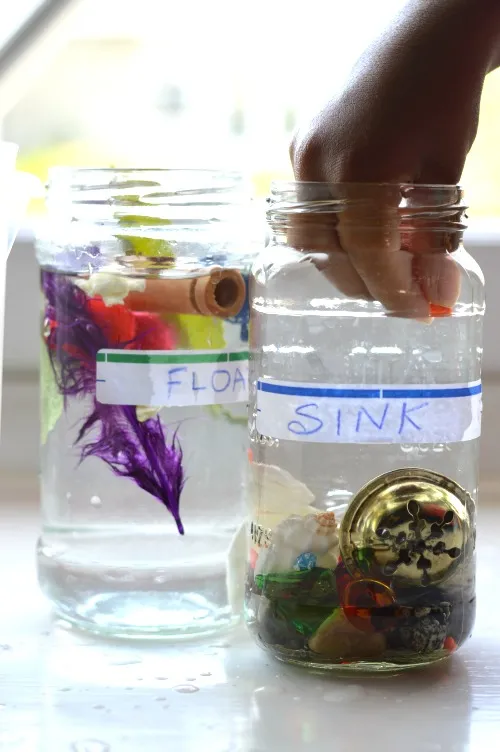
Label two jars 'Float' and 'Sink'.
Gather leaves, twigs, stones and pebbles from outside.
Optional: print a sink or float record sheet for each child.
Steps
Fill a simple round container with water.
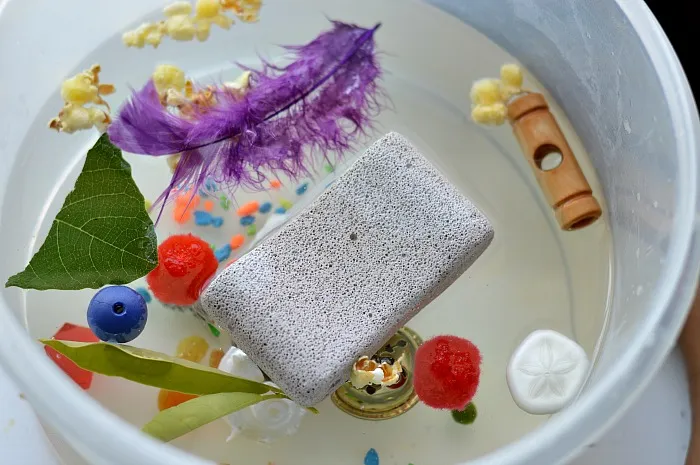
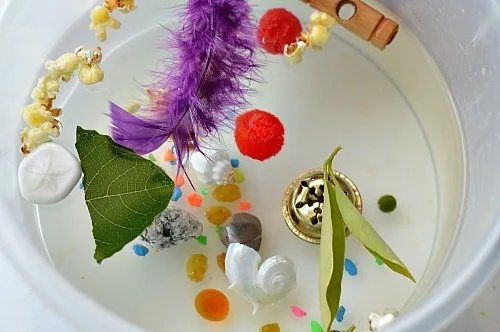
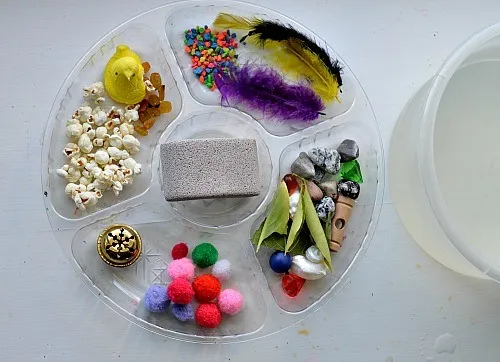
Set out the test materials: pom poms, leaves, twigs, stones, pebbles, gravel, popcorn, raisins, a bell and feathers.
Pick one object and guess: will it float or sink?
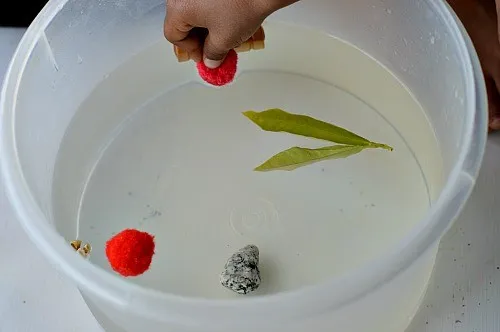
Drop it in the water and check whether your guess was right.
Keep guessing and testing until every object has had a turn.
Feel the pumice 'stone' and predict what it will do, just like the other stones.
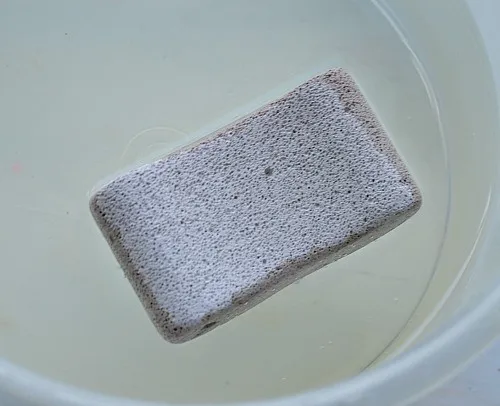
Put the pumice stone in the water and watch it float.
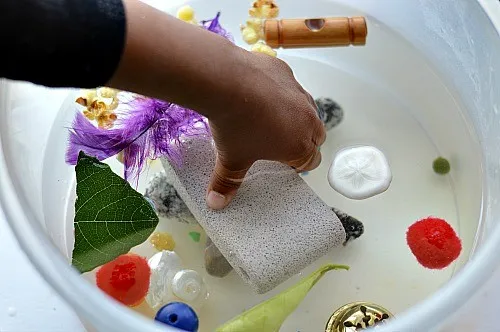
Try pushing the stone to the bottom and watch it come back up.
Look closely: most of the stone is under the water, and only the top sits above the surface.
Sort the materials into the 'Float' and 'Sink' jars and keep watching them.
Tips
We used a wide variety of materials to see the contrast.from the author
The popcorn was their favorite.from the author
Hold the pumice back until the end. The word 'stone' sets kids' minds on 'sink', especially after the other stones and pebbles have gone straight to the bottom, so it feels like a magic stone when it floats.from the author
Why it floats: pumice is a highly porous material made of volcanic ash. Its air cavities make it really light. Left in the water for a long time, water fills the cavities and it eventually sinks.from the author
We didn't use an observation sheet, but a simple printable (the author likes Buggy and Buddy's) lets kids record their predictions and results.from the author
Repeat the experiment later with new materials to see what the kids remember about the different variables.from readers
Make it your own
Leave the pumice stone in the water for a long time and check back to see when it finally sinks.
Use a sink or float printable to record predictions and results.
Repeat later with a new set of materials to see what kids remember.
The story behind it
By TurkeyMom · May 2014
We used a wide variety of materials to see the contrast. I used a simple round container, filled it up with water and set out the materials pictured above.
The kids enjoyed first guessing whether the object will float or sink and immediately compared their predictions with the actual results. The popcorn was their favorite.
Then I introduced a fun material, a bath pumice "stone". Both kids felt it and decided it would sink just like the other stones and pebbles that went straight to the bottom.
But to their surprise this "stone" floats. Yes, it floats for a long time. A large part is submerged while the top stays above the water, but to kids this "magic" stone is floating.
The kids tried pushing it down to the bottom but it would come back up. Pumice is a highly porous material made of volcanic ash, and its air cavities make it really light.
The pumice floats for a while among all our materials. Leaving it in the water for a long duration makes the water enter the cavities, and it does eventually sink to the bottom.
Later I set out 2 jars with labels on them, and the kids sorted the materials into the jars for extended observation.
1 / 7
🔇 No sound? Turn off silent mode (the switch or Action button on the side of your iPhone) and check the volume.
What readers say
💬 1 comments
🎉 Worked for us
Redo it to check what stuck
A parent had already run a quick version with her boys to teach variables, and plans to repeat it with these materials to see what they remembered.
“I did this experiment quickly with my boys to teach them about the different variables”
Recently tried
Read all 1 comments
PinkOddy · May 2014
I did this experiment quickly with my boys to teach them about the different variables - I might just do it again with some of your materials and see what they remembered. Thanks for sharing.
Read all 1 comments
PinkOddy · May 2014
I did this experiment quickly with my boys to teach them about the different variables - I might just do it again with some of your materials and see what they remembered. Thanks for sharing.